Time to Network
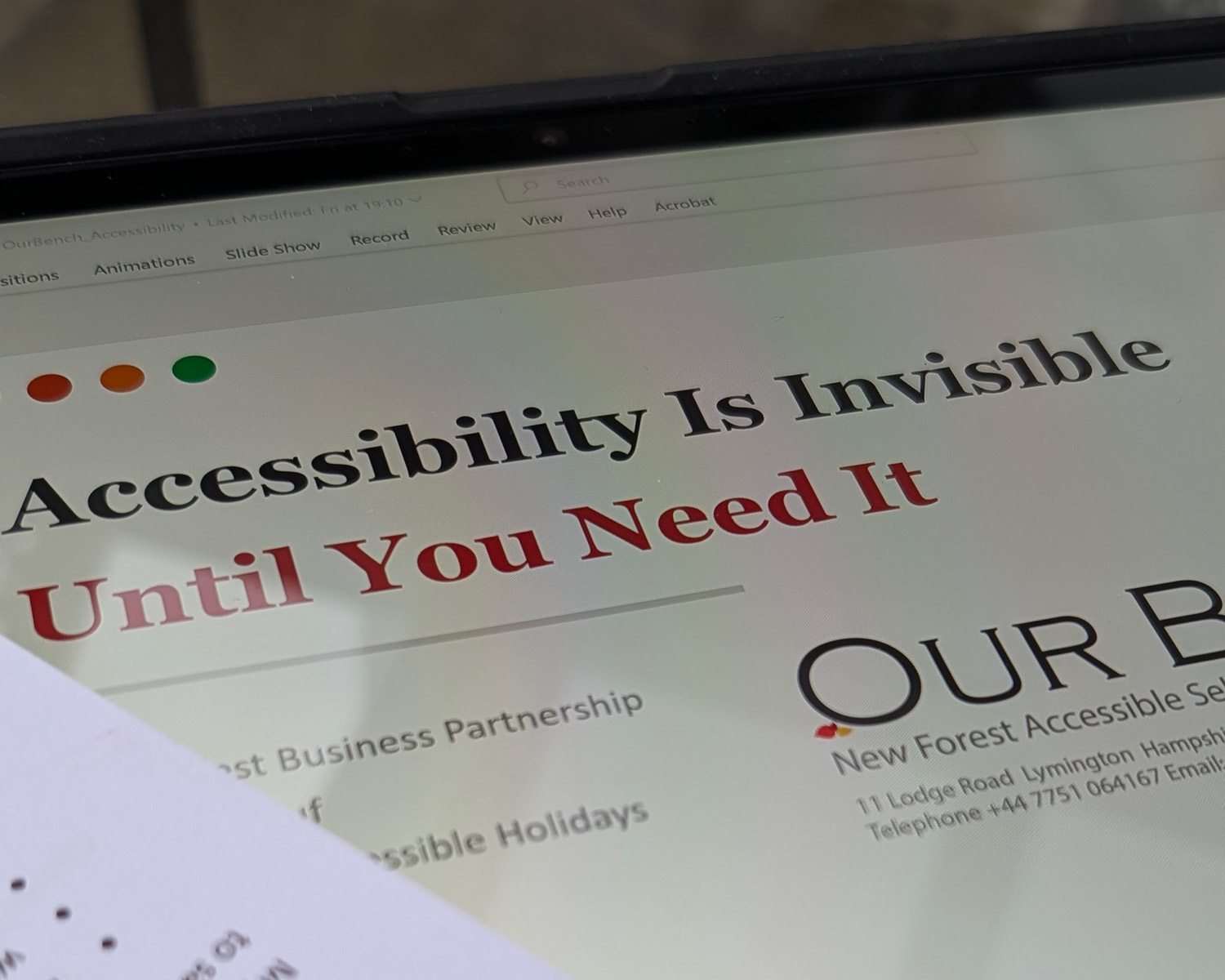
Networking with local businesses is where conversations start, and where real change for accessibility can begin. For the first time in years, I have the time to attend business networking events, meet other business owners, learn new skills, and make sure Our Bench is properly connected within the local community.
The reason I wasn't there before was the same reason many disabled people and carers stop attending, not because I wasn't interested, it was because it was too hard. Juggling the demands of caring, the need for accessible venues if my business partner attended, and the inability to commit because the unexpected was actually an expected normal.
Disability is not a topic people want to discuss
Introducing yourself as a disability-focused business owner can be enlightening. Sometimes eyes glaze over, conversations move on quickly, and people don’t quite know what to say.
I’m not the only one who has noticed this. The amazing Sam from Driving Miss Daisy has shared similar experiences.
Yet in the UK there are 16.8 million disabled people (Department for Work and Pensions, Family Resources Survey 2023-24). Around 25% of small business owners are disabled or have a health condition, and 41% of small businesses have employed a disabled person in the past three years (Business Without Barriers, FSB).
With numbers like that, disability should not feel like a niche topic.
But after attending many events, I have started to see the real issue: communication.
- Events are advertised with no accessibility information and no guidance on how to ask for help.
- Venues often have no access information on their websites.
- I have attended events in venues with level access and large accessible toilets with space for lateral transfer, yet no one knows, not even the host.
- I have attended events at hotels with only one or two steps and excellent accessible toilets, but there is no signage on the website or in the building telling you where they are.
- I have also attended events up two flights of stairs with no warning beforehand.
The Sunflower Lanyard
The Hidden Disabilities Sunflower is a simple way for someone to voluntarily share that they have a condition that may not be immediately obvious.
I decided to adopt their supporter lanyard and carry a RADAR key. They have become small conversation starters, and the conversations have started to open up, one person at a time.
- "I have been diagnosed with MS and I don't know what my future holds."
- "I work in recruitment and am struggling to find a role for a person with muscular dystrophy."
- "Standing on a cold floor is hard."
- "I can't hear very well."
- "My dad has mobility issues and it’s so hard."
- "My son uses the disabled toilet as he has ADHD and forgets. Where do you get a key from? We can't use them if they are locked."
My Experience
My experience comes from many directions, as a carer, a mum, a daughter, an aunt, a friend, a neighbour and as a business owner where disability is part of everyday life.
Because of that lived experience, I often see possible solutions straight away, or I have an idea where to start looking. What I also see is that many businesses are simply nervous of getting it wrong.
I have heard things like:
- “Our toilets are not fully accessibility compliant because they lack an emergency alarm due to where they are situated, so we haven't told anyone about them.”
- “We are not wheelchair accessible so we don’t need to say anything.”
- “We have a downstairs meeting room but no one knows about it.”
- “We have never had a disabled customer.”
When I hear that last one, I often ask a simple question: is there an invisible barrier preventing them from accessing your business?
Actioning Change - One Conversation at a Time
I can’t do nothing about it. Disability is the only minority group that any of us can join at any time.
For many of our guests, disability is something that happened suddenly. If I can encourage just one business to think differently, change can start to happen.
- I started big and contacted Forestry England about the lack of accessibility information on their website. Change has already started to happen. One question can make change happen. They have promised to update their information.
- At one networking meeting I introduced myself by saying I was only there to check whether the venue had an accessible toilet. I asked the room if anyone knew. The room went silent. I then pointed out the venue had step-free access and a side transfer toilet, which I would happily share with my guests. But it should not require a site visit or phone call to discover that information.
- I met with an event organiser promoting weddings in the New Forest and asked if she could count how many visually disabled visitors attended their multi-venue wedding weekend. She asked and there were none. We now have a meeting planned to explore why.
- I met with the volunteers behind the New Forest Business Partnership with the idea that if they included access information on their website, and started asking venues about access and encouraging access statements, businesses might begin to share the facilities they already have.
- I also have a meeting with the Oakhaven Business Club. Interestingly, the attendee was anxious about hosting because I have a dog, so I moved the meeting location. That decision itself opens an important conversation about how difficult it can be to say what you need, and how hosts need to be able to adapt. How anxiety can be disabling, and how even their own hospice wellbeing suite at that time didn't share even a simple access statement.
Watch this space.
What I know is that the solutions are often simple. The barriers usually come down to lack of experience, lack of knowledge, lack of information, or simply lack of communication.
Through the lived experiences of Our Bench's guests over the past 25 years, and my own personal experience, we often see opportunities to improve things, sometimes through very small changes, at minimal cost, but those changes can make a huge impact.
- A conversation with a garden attraction highlighted that their accessible toilet had a one-inch step. They thought it could not be solved. A simple one-inch ramp solved the issue while still allowing the door to close safely.
- A local social club had level access but very heavy doors that wheelchair users could not open independently. A small adjustment costing less than £20 solved the problem.
- A community hall had a door frame that prevented wheelchair access. A lightweight temporary ramp for events made the building usable, and the wheelchair user was quite happy to donate it for the hall to use.
- A conversation with a GP helped an autistic adult understand that they were entitled to their own disabled bus pass when they struggled with the concept of payment.
- A conversation with a chartered accountant in Southampton lead to more awareness, a look online to see their company didn't have an access statement - but the result a great access statement that we have chosen to add to our example page - they already had the facilities and the practice - they just weren't sharing the information!
Continue the Conversation
Many of the small changes described here did not come from formal consultancy or policy documents. They came from conversations.
A quick question about a doorway. A chat about how someone arrives at a venue. A moment of curiosity about whether information exists online.
Through running Our Bench for more than 25 years and listening to the experiences of our guests, we have seen how small adjustments can remove barriers and help more people feel welcome.
If you run a local business, organise events, or manage a venue and would like to explore accessibility in a practical way, I am always happy to share ideas and lived experience. If you want to learn more about what an access statement is, we can help.
Sometimes the first step is simply asking the question.
Last updated: March 2026