A real accessible gem, hidden in the centre of Lymington
Visited and website information checked: September 2026
I visited Lymington Community Centre today and came away thinking two things.
Firstly, what a useful and welcoming community space we have right in the
centre of Lymington.
Secondly, why aren't we telling more people just how accessible it is?
I was at the Community Centre for a Lymington Chamber of Commerce business
networking event. I went along to meet other local businesses and learn
more about the role of our volunteer air ambulance here in Hampshire.
I expected to come away knowing more about the incredible work of the air
ambulance. I didn't expect to discover one of Lymington's hidden
accessibility gems at the same time.
For a disabled visitor, knowing that somewhere describes itself as
"accessible" isn't always enough. I want to know what that actually means.
Can I park nearby? Can I get through the door? Can I move around once I'm
inside? Is there an accessible toilet? Can I sit comfortably and have a
coffee?
So, here's what I discovered.
Ahead of the Event: What Could I Find Out?
Before going somewhere new, a disabled visitor may want to know a little
more than simply the address. The networking advert had no accessible information, so the next place to research was the actual venue.
At the time of my visit in September 2026, the Lymington
Community Centre website made some useful information clear. I could see
that the Centre was in New Street in central Lymington, that it had a café,
cinema and theatre, and that it was a busy community venue offering a wide
range of activities, groups, classes and events.
The website also stated that there were disabled/accessible facilities in
the main building and Gates Hall, and that a RADAR key was available from
reception.
So I knew that disabled visitors had been considered.
What wasn't immediately obvious was what "accessible"
actually meant for my visit.
Could I park close to the entrance? Was there somewhere suitable for a
wheelchair drop-off? Was the entrance level? Could I get into the café
without encountering a step? Would there be enough room to manoeuvre around
the tables? Could I get outside into the courtyard?
And while I knew there was an accessible toilet, I had no idea what was
actually behind the door.
Some additional access information can be found by digging deeper into the
website. For example, individual room descriptions identify accessible
ground-floor rooms, lift access to some first-floor rooms, rooms which are
only accessible by stairs, and some hearing-loop provision.
That's all useful information, but it's not necessarily information I'd
discover when simply checking:
"I'm going to a networking event in the café. Can I get in and use
the facilities?"
So I arrived knowing the Centre said it had accessible facilities, but
without a clear picture of what my accessible journey through the building
would actually look like.
What I found when I arrived was considerably more useful than the website
had led me to expect.
Arriving at Lymington Community Centre
The Community Centre is brilliantly positioned for exploring Lymington.
There is disabled members' parking close to the door and space for
wheelchair drop-off. For other visitors, the NFDC public car park is around
a two-minute walk away.
From here you're also close to Lymington town centre and St Barbe Museum
and Art Gallery, making the Community Centre a useful starting point or
stopping place during a visit to the town.
Both Community Centre buildings have lowered thresholds, making wheelchair
access easier.
Inside, I found a friendly reception team. A RADAR key for the accessible
facilities is available from reception, so you don't need to worry if you
haven't brought your own.
Can I Just Come Here for Coffee?
Yes, and this is something I think more people should know.
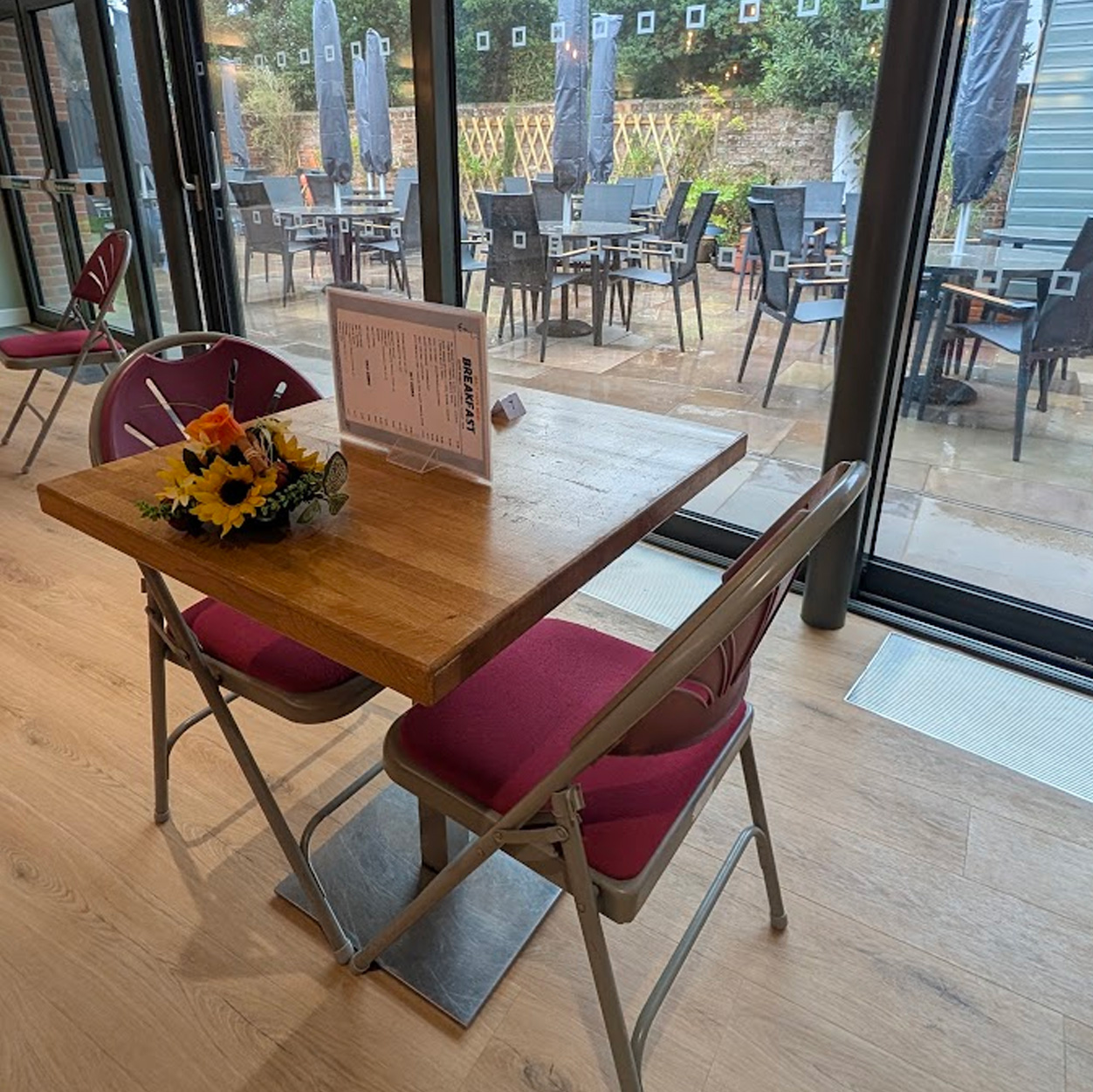
The café is level and spacious, with tables that can easily be moved to
create room for wheelchair users. Prices are reasonable, it's
air-conditioned, and there is also an outdoor courtyard with a level
threshold.
That matters.
You don't necessarily have to be attending a class, joining a group or
going to an event. This can simply be somewhere in central Lymington to
meet somebody, have a coffee or spend a little time, and you don't need to be a member of the Community Association.
I had a great breakfast and then I went to look at the accessible loo.
The Hidden Gem Behind the RADAR-Key Door
Calling this simply a "disabled toilet" really doesn't tell the story.
It's huge.
There is substantial manoeuvring and changing space, an accessible WC with
support and drop-down rails, basin, shower area and privacy screen.
Most significantly, there is an
electrically height-adjustable adult changing and showering table.
The Astor Bannerman CTE2-CP changing table is marked with a maximum load
of 200kg / 440lb and can be electrically raised and
lowered.
I'd describe this as a Changing Places-style accessible toilet and
adult changing facility, but there is an important difference:
there isn't a hoisting facility.
That is important information for anyone who requires a hoist for
transfers, and this shouldn't be confused with a fully equipped Changing
Places toilet.
But there are many disabled people who don't require a hoist and
do need an adult-sized changing surface, and here it was hidden away behind a locked door and the signage didn't even give you a clue!
For some families, knowing this facility exists could make the difference between being able to spend time in Lymington and having to cut a visit short. It could mean a loved one can be changed somewhere clean and safe, on an adult-sized changing surface, rather than on a bathroom floor.
And I nearly didn't know it existed. If I hadn't opened the door, it may have remained Lymington's best kept secret!
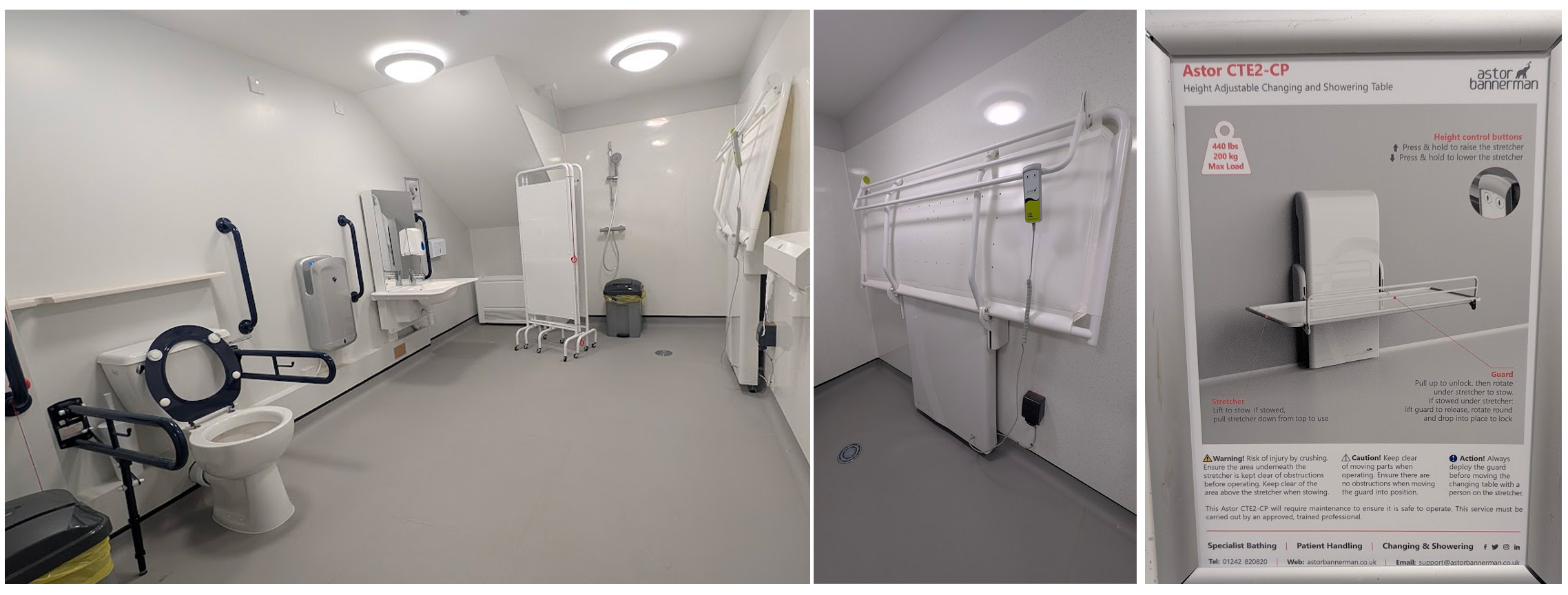
The amazing hidden toilet with height adjustable changing bench
More Than Somewhere to Have a Coffee
The Community Centre isn't really one thing.
It houses The Malt Cinema and theatre, rooms and halls used for activities
and community groups, classes, events and meetings, as well as the café.
There's even a charity book section as you come in.
So you could browse for a book, have a coffee, meet a friend, attend an
activity or event and, crucially for some disabled visitors, know that
there's somewhere available to meet a basic personal-care need.
Then you're already in the heart of Lymington to explore more of the town.
While I was there I chatted with one of the trustees. He talked about how
important community has become, particularly when so many people today can
find themselves alone.
Looking around the Centre, I could see exactly what he meant.
There are people, activities and reasons to come through the door.
But first, people need to know that they can come through the door.
That's Where Access Information Matters
This visit highlighted something I've become increasingly interested
in when looking at accessibility across the New Forest.
Businesses and organisations sometimes have much better accessibility
than disabled people can discover online.
At the time of my visit in September 2026, Lymington Community Centre's
website did contain some useful access information.
It told visitors that there were disabled/accessible facilities in the
main building and Gates Hall and that a RADAR key was available from
reception.
Elsewhere, its room information identified accessible ground-floor rooms,
lift access to some first-floor rooms, rooms which could only be reached
by stairs, and some hearing-loop provision.
That's useful information, but it's scattered around the website and takes time to find.
If I'm simply a wheelchair user wondering:
"Can I meet a friend for coffee here?"
I have to piece the answer together.
And I still wouldn't discover one of the Centre's most impressive
accessible facilities: that enormous changing room and adult changing
table.
That's the hidden gem.
This reflects the information I could find on the Community Centre website
in September 2026. Websites change, and I very much hope that if you're
reading this in the future, you'll find even more access information
available, but I want to use this to share with you why I am so passionate to share information.
Why an Access Statement Matters
I think every business and visitor attraction should consider
having a simple Access Information page or access statement.
It doesn't need to promise that somewhere is "fully accessible".
In fact, I'd rather it didn't. It just needs to be honest.
Tell me where I can park, what the entrance is
like, whether there are steps or thresholds, how wide the doors are,
whether there's a lift, what seating is available, what the toilet
contains, whether there's a changing bench or hoist, whether assistance
dogs are welcome, and anything else I might need to know.
Add photographs wherever possible.
Give me the information and let me decide whether your business works for my individual needs.
Lymington Has a Little Gem Here
That's what I came away thinking. I couldn't believe this was here, so close to the town centre and I didn't know. This week I was asked to suggest a cafe for three wheelchair users and five carers to enjoy a coffee with friends - this would have been my first choice as it is walkable from our holiday cottages and the guests could have spent the day enjoying what Lymington has to offer.
Lymington Community Centre already has the location, the café, the
facilities, the activities and, most importantly, the people creating a
community around it.
For some disabled visitors, it also has a facility that can be remarkably
difficult to find when you're away from home:
a proper adult changing surface with plenty of space around it.
No hoist. That's important to say. But not everyone needs a hoist.
But it is equally important to say what is there.
Because accessibility isn't only about making changes to buildings.
In this case the lowered threshold is already there.
The spacious café is already there.
The changing table is already there.
We just need to tell people.
And That's Where Access Information Matters
Website information reviewed: September 2026.
Remember what I knew before I arrived: the Centre had told me it had
accessible facilities, but I didn't really know what that meant for me.
By the time I left, I knew about close disabled members' parking and
wheelchair drop-off, lowered thresholds, a spacious level café, movable
seating, level access to the courtyard and an exceptionally spacious
accessible toilet and adult changing facility.
The building hadn't become more accessible during my visit. My
information about it had.